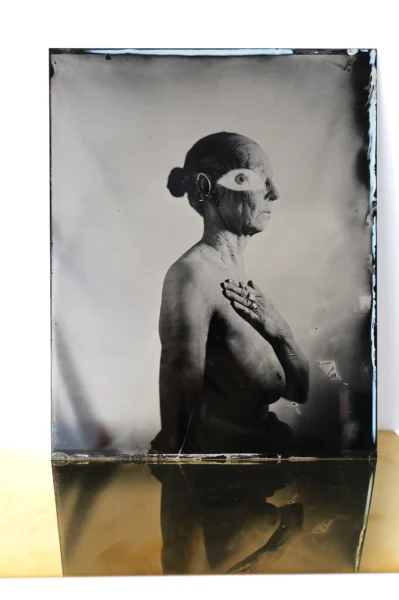
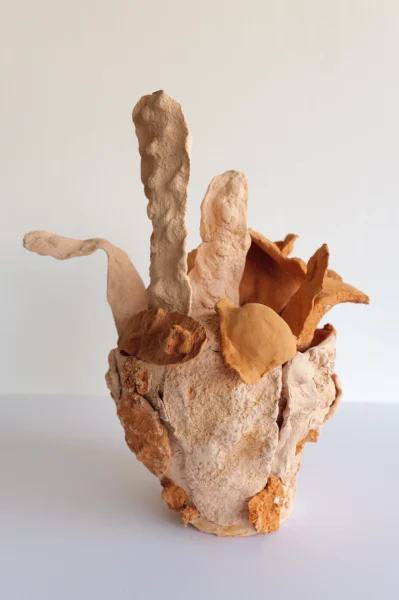
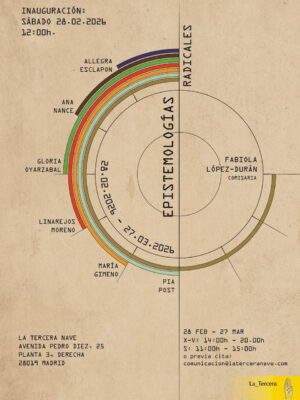
Walter Benjamin argued that all knowledge emerges from the fragment, from the ruin, from the leftover, since it is precisely in their incompleteness that what things have been and what they continue to be illuminate one another. To privilege the fragmentary and the discontinuous as a form of constructing knowledge is, in this sense, a radical practice: a critique of the epistemological imperialism of that history and that science which have claimed to be universal, objective, and neutral. It is in this way that Allegra Esclapon, Ana Nance, Gloria Oyarzabal, Linarejos Moreno, María Gimeno, and Pia Post —the artists of La Tercera Nave – question, through their diverse practices, the very foundations of knowledge. Rather than asking how we know, they interrogate the exclusions that sustain the construction of knowledge, the violences inscribed within it, and the possibilities that exist for imagining more just forms of knowledge and more just futures. Their works unfold open, unstable, contingent, and even anachronistic epistemological systems; practices attentive to gesture, processes, emotion, and absence, in which art asserts itself as a political space and an ethical exercise. In the work of these six artists there exists a deep commitment to that which resists and survives, an innovative cognitive attitude that disrupts the apparent continuity of time and history, revealing hidden structures and invisibilized trajectories, while looking toward the future with hope through their reparative labor in fractured worlds.
Fabiola López-Durán
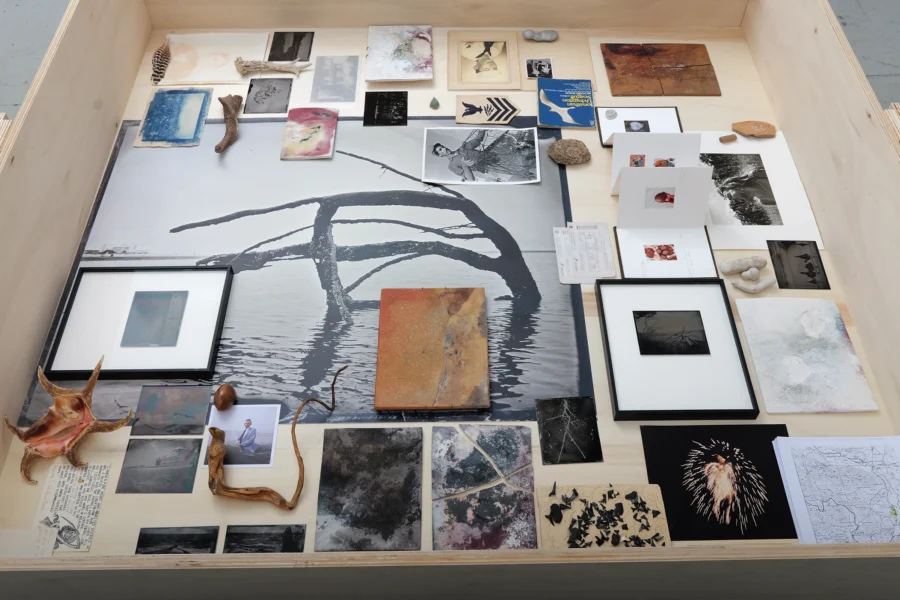
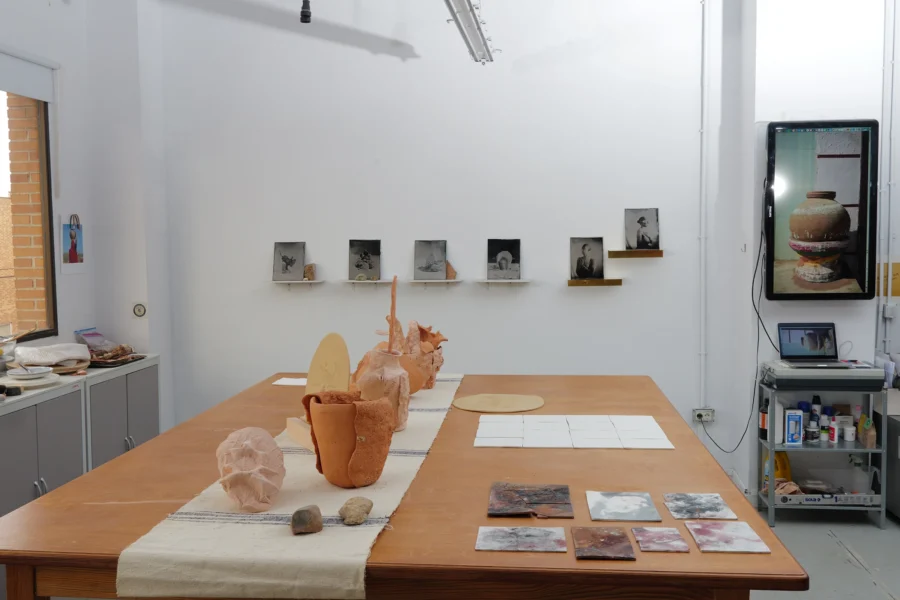
For Ana Nance and Linarejos Moreno, knowledge is constructed from territory and archive, and through the juxtaposition of heterogeneous cognitive processes: from scientific methodologies and infographics to ancestral practices and oral traditions—both collective and empirical—capable of transmitting intangible cultural heritage. Ana delves into the territory of her ancestors as a field of material and symbolic research: she gathers history in its omissions and fragments, models her land as an archive, and transforms it into intimate records of existence. At the same time, she juxtaposes landscape and personal territory with episodes of conflict, pleasure, resistance, and culture recorded in her own world archives, thus configuring a visual device in which memory, experience, and spatiality converge critically. Linarejos, on the other hand, questions the supposed objectivity and accuracy of classificatory geographies and infographics: from Alexander von Humboldt’s phytogeographies—designed to represent the geographical distribution of plant species in the Americas—to mathematical formulas for calculating the age of trees or grids for mapping the expansion of the livestock industry. As scientific annotations inscribed on the landscape, her research produces a form of knowledge that opposes the extractivist logics of capitalism and the structures of labor exploitation, racial segregation, and environmental injustice that sustain it.
This website uses cookies to improve your experience. We'll assume you're ok with this, but you can opt-out if you wish. Cookie settingsACCEPT
Privacy & Cookies Policy
Privacy Overview
This website uses cookies to improve your experience while you navigate through the website. Out of these cookies, the cookies that are categorized as necessary are stored on your browser as they are essential for the working of basic functionalities of the website. We also use third-party cookies that help us analyze and understand how you use this website. These cookies will be stored in your browser only with your consent. You also have the option to opt-out of these cookies. But opting out of some of these cookies may have an effect on your browsing experience.
Necessary cookies are absolutely essential for the website to function properly. This category only includes cookies that ensures basic functionalities and security features of the website. These cookies do not store any personal information.
Any cookies that may not be particularly necessary for the website to function and is used specifically to collect user personal data via analytics, ads, other embedded contents are termed as non-necessary cookies. It is mandatory to procure user consent prior to running these cookies on your website.